How to crack coding interviews in 2026: A complete and practical guide for software engineers!

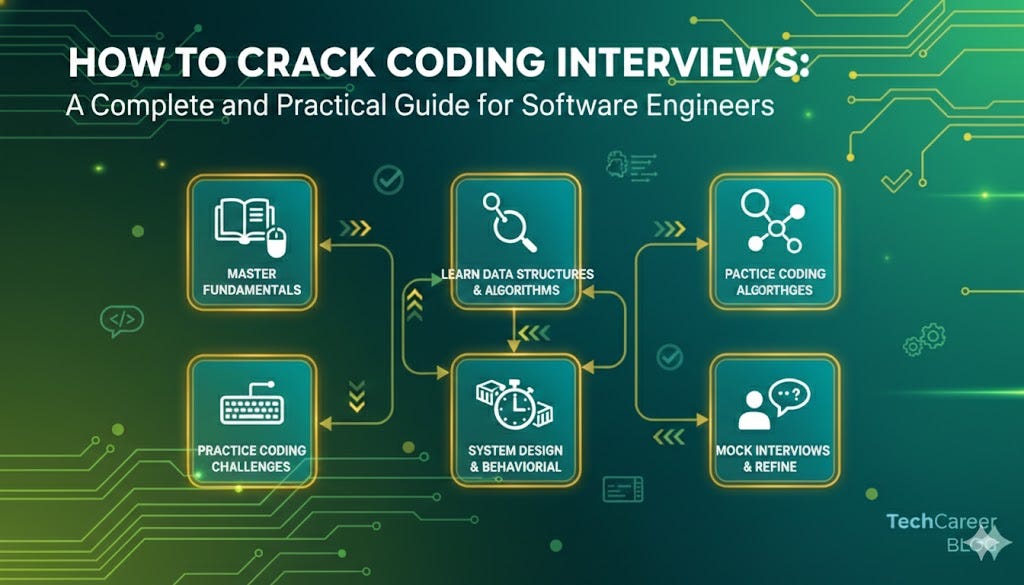
How to crack coding interviews: A complete and practical guide for software engineers
Cracking coding interviews is one of the most important steps in building a successful software engineering career. Whether you are a college student, a fresher, or an experienced developer preparing for a job switch, coding interviews often feel intimidating and unpredictable.
Many candidates believe that only “naturally smart” people crack coding interviews. That belief is incorrect. Coding interviews are not about raw intelligence. They are about structured thinking, preparation, and communication. With the right approach, anyone can significantly improve their performance.
This guide explains how to crack coding interviews step by step, using proven preparation frameworks, interviewer insights, and common mistakes to avoid. The explanations are practical, easy to understand, and designed to help you perform confidently in real interviews.
What is a coding interview?
A coding interview is a technical interview round where companies evaluate your ability to solve programming problems under time constraints. The goal is not just to see whether you can write code, but whether you can think like a software engineer.
Most coding interviews last between 30 and 45 minutes. During this time, you are usually given one main problem and sometimes one or more follow-up questions. You are expected to understand the problem, design an approach, write working code, and explain your reasoning clearly.
Coding interviews usually focus on data structures, algorithms, and problem-solving skills. For mid-level and senior roles, they may also include system design, but strong fundamentals are always required.
If you’re preparing for coding interviews, you can get personalized support through 1:1 tech mentorship at Everyone Who Codes. Their mentorship sessions focus on data structures, algorithms, system design, and real interview practice to help you build confidence and improve problem-solving skills. You can book a dedicated 1:1 session here: https://everyonewhocode.com/services/1-1-tech-mentorship/.
Learn more about their overall interview preparation and mentorship offerings on their official website: https://everyonewhocode.com/
Why coding interviews feel difficult?
Coding interviews feel hard because they test multiple skills at the same time. You are expected to think logically, code correctly, communicate clearly, and manage time all while being observed.
Another reason interviews feel difficult is that many candidates prepare in an unstructured way. They solve random problems without understanding patterns, memorize solutions instead of concepts, or focus only on coding and ignore communication.
The pressure of a live interview environment can also affect performance. Even strong developers may struggle if they are not used to explaining their thoughts out loud or coding under time limits.
The good news is that these challenges are common, and they can be overcome with the right preparation strategy.
How do interviewers evaluate candidates?
To crack coding interviews, you must understand how interviewers think. Most companies evaluate candidates using similar criteria, even if the exact scoring system differs.
Interviewers usually assess problem-solving ability first. They want to see whether you can understand the problem quickly, ask the right questions, and break it down logically. They are interested in how you approach the problem, not just the final answer.
Data structures and algorithms knowledge is another major factor. Interviewers look for appropriate choices, such as using a hash map instead of nested loops or applying binary search when the input is sorted. They also expect you to understand time and space complexity.
Coding quality matters as well. Clean, readable code with meaningful variable names creates a strong impression. Small mistakes are acceptable, but messy or confusing code is a red flag.
Finally, communication plays a critical role. Candidates who explain their thinking clearly, respond well to hints, and collaborate with the interviewer often perform better than silent candidates with perfect logic.
The right mindset for coding interviews
Before discussing preparation, it is important to adopt the right mindset. Coding interviews are not exams. They are collaborative problem-solving sessions.
Interviewers are not trying to trick you. They want to see whether you can work through problems logically and communicate effectively. If you make a mistake but explain your reasoning well and correct yourself, that is often seen as a positive signal.
You should also remember that optimization is not always required immediately. Interviewers prefer a correct and clear solution first, followed by improvements if time allows.
Approaching interviews with curiosity instead of fear can significantly improve your performance.
