How to Prepare Data Structures and Algorithms for Interviews: A Clear, Practical Guide that actually works!


Preparing for Data Structures and Algorithms (DSA) interviews is often more stressful than learning any new programming language or framework. Many engineers with solid real-world experience still struggle to clear coding interviews, even after weeks or months of practice.
This happens because DSA interviews are not testing what most people think they are testing.
They are not checking how many problems you have solved or whether you remember the syntax of a specific algorithm. Instead, they are designed to evaluate how you think under pressure, how you break down unfamiliar problems, and how clearly you communicate your reasoning.
This guide explains how DSA interviews actually work and how to prepare for them in a structured, realistic way that produces consistent results.
DSA Interview preparation in simple terms
DSA interviews test structured thinking, pattern recognition, and clarity of explanation, not memorization. The most effective way to prepare is by mastering core problem-solving patterns, building strong fundamentals, practicing with time limits, and taking mock interviews. A three-phase roadmap, foundations, intermediate patterns, and advanced concepts helps most candidates become interview-ready in two to four months with consistent practice.
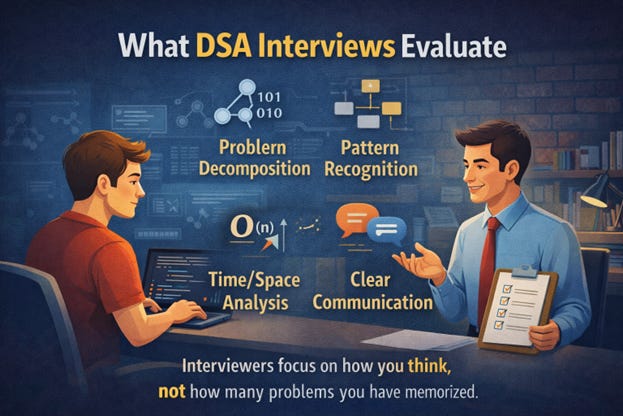
What DSA Interviews are really designed to evaluate
A DSA interview is a controlled problem-solving exercise. Interviewers want to understand how you approach a problem when the solution is not immediately obvious.
They observe how you analyze constraints, whether you can identify an appropriate data structure, and how you move from a naive approach to an optimized one. Clear communication matters just as much as correct logic. Explaining why a solution works often carries more weight than writing flawless code.
Candidates who pause to clarify assumptions, talk through trade-offs, and adapt their approach tend to perform well, even if they make small mistakes. On the other hand, candidates who rush into coding without a plan or struggle to explain their logic usually fail, even if they eventually reach a working solution.

Why most Candidates fail DSA Interviews despite practicing LeetCode
Many candidates spend weeks solving problems on platforms like LeetCode, yet still fail interviews. The issue is rarely effort, it is strategy.
Most people practice randomly. They solve whatever problem appears next, without grouping problems by concept or pattern. This leads to shallow familiarity rather than deep understanding. When the interview problem looks slightly different, panic sets in.
Another common mistake is memorization. Candidates remember solutions but forget why they work. In interviews, where problems are intentionally tweaked, memorized solutions collapse quickly.
Effective preparation requires structure, repetition, and reflection not just volume.
Why pattern-based DSA preparation works better than random practice
Almost every DSA interview problem belongs to a small set of recurring patterns. Once you recognize the pattern, the problem becomes far less intimidating.
Pattern-based preparation trains your brain to categorize problems instead of treating each one as new. Over time, this dramatically reduces cognitive load and improves speed.
Common patterns include two pointers, sliding window, hashing, binary search, recursion, backtracking, dynamic programming, and graph traversals. Interview questions are simply variations of these ideas.
Instead of asking whether you have solved a problem before, you start asking which pattern it uses. That shift alone changes interview outcomes.
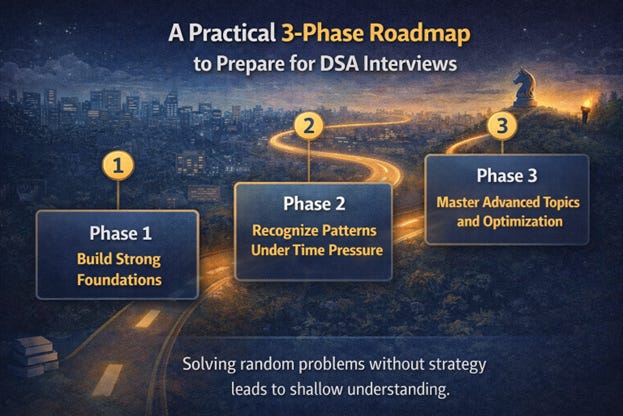
A Practical 3-Phase roadmap to Prepare for DSA Interviews
A structured roadmap prevents burnout and ensures steady progress. Rather than learning everything at once, preparation should happen in phases.
Phase 1: Build strong foundations
The first phase focuses on core data structures and basic problem-solving techniques. Weaknesses here will surface later, so this stage should not be rushed.
During this phase, concentrate on arrays, strings, hash maps, stacks, queues, and linked lists. The goal is clarity, not speed. You should understand when to use each structure and how it affects time and space complexity.
At this stage, easy problems are sufficient. Focus on writing clean code and explaining your logic clearly. Confidence built here carries forward into more complex topics.
Phase 2: Learn to recognize patterns under time pressure
The second phase is where most interview readiness is built. This stage focuses on intermediate concepts such as binary search variations, trees, recursion, sorting algorithms, and sliding window problems.
Medium-level problems should become your primary focus. This is also when timed practice becomes essential. Learning to think clearly under time constraints is a skill that must be trained intentionally.
By the end of this phase, you should be able to identify patterns quickly, explain your approach before coding, and adjust your solution when constraints change.
Phase 3: Master advanced topics and optimization
The final phase covers advanced concepts such as dynamic programming, graph algorithms, backtracking, and tries. These topics often intimidate candidates, but they become manageable when approached step by step.
Start with brute-force solutions and gradually optimize them. This mirrors how interviewers expect you to think. The emphasis here is on explaining why an optimized solution is better, not just writing it.
Strong candidates at this stage can articulate trade-offs, handle edge cases confidently, and remain calm even when problems are challenging.
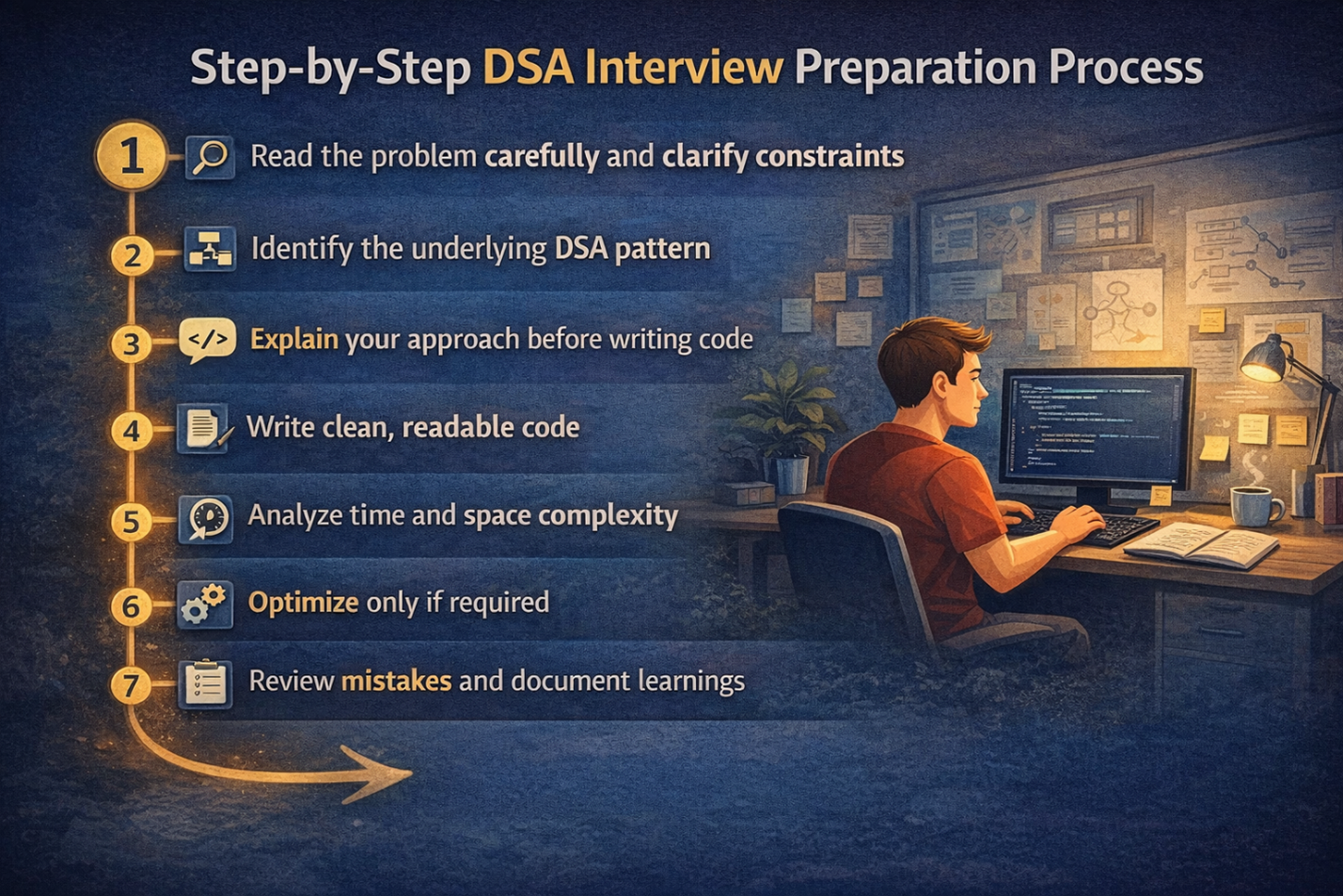
Step-by-step DSA Interview preparation process
A repeatable process makes preparation predictable and effective.
Read the problem carefully and clarify constraints
Identify the underlying DSA pattern
Explain your approach before writing code
Write clean, readable code
Analyze time and space complexity
Optimize only if required
Review mistakes and document learnings
This process closely matches how interviewers evaluate candidates during real interviews.
How to practice DSA problems effectively
The quality of practice matters more than the number of problems solved.
Begin by analyzing the problem deeply before coding. Understand what the input size implies about possible solutions. Attempt a solution even if you are unsure productive struggle builds intuition.
If you get stuck, study the optimal solution carefully, focusing on the reasoning rather than the code. Then re-implement the solution from scratch without looking. This reinforces understanding and builds long-term confidence.
Time management rules for DSA practice and interviews
Practicing without time limits creates a false sense of readiness. Interviews are timed, and preparation must reflect that reality.
As a general guideline, spend no more than fifteen minutes on easy problems, thirty minutes on medium problems, and up to an hour on hard problems. If you exceed the limit, stop, review the solution, and move on.
Learning when to let go is an essential interview skill.
Common mistakes that hold candidates back
Many candidates unknowingly sabotage their preparation. Over-memorization, avoiding difficult topics, skipping revision, and neglecting mock interviews are common issues.
Another frequent mistake is ignoring communication. Interviewers care deeply about how clearly you explain your thinking. Practicing explanations out loud is just as important as writing code.
Are Mock Interviews necessary for DSA preparation?
Yes. Mock interviews are one of the most effective tools for improvement.
They simulate real interview pressure, expose weak areas, and improve communication skills. Even highly prepared candidates benefit from mock interviews because they reveal blind spots that solo practice cannot.
Treat mock interviews seriously and reflect honestly on feedback.
How to prepare for DSA while working full-time
Many candidates worry that a full-time job makes DSA preparation impossible. In reality, consistency matters more than long study hours.
Short, focused sessions during weekdays combined with longer revision sessions on weekends work well for most people. Avoid burnout by setting realistic goals and taking breaks when needed.
Progress made steadily compounds over time.
How long does it take to become Interview-ready?
Most candidates become interview-ready within two to four months of structured preparation. The exact timeline depends on prior experience, consistency, and quality of practice.
Rushing the process often leads to repeated failures. Depth of understanding matters far more than speed.

Frequently asked questions about DSA Interview preparation
How should beginners start preparing for DSA interviews?
Beginners should focus on building strong fundamentals in arrays, strings, hash maps, stacks, and linked lists before moving to advanced topics.
Is solving problems daily enough to crack DSA interviews?
No. Daily practice without structure leads to shallow learning. Pattern recognition and timed practice are essential.
Are platforms like GeeksforGeeks and HackerRank useful?
Yes. Platforms such as GeeksforGeeks and HackerRank are valuable when used with a structured approach rather than random problem solving.
Expert insight on DSA interviews
Experienced interviewers consistently emphasize that DSA interviews are designed to evaluate reasoning, adaptability, and communication rather than memorized solutions. Candidates who prepare using structured patterns and timed practice consistently outperform those who rely on brute-force grinding.
Final thoughts: DSA Is a learnable skill
DSA interviews are not a test of innate intelligence. They reward preparation, structure, and disciplined thinking.
With the right approach, consistent practice, and a focus on patterns rather than memorization, cracking coding interviews becomes predictable rather than stressful.
For candidates seeking structured mentorship, interview-focused preparation, and guided learning paths, simlar resources and structured courses to get job offers available at https://everyonewhocode.com/
Really solid breakdown of the pattern-first methodology. The emphasis on "categorical thinking" over brute-force grinding addresses why so many enginers plateau after 200+ problems on HackerRank but still fail interviews. I've found that the phase-based roadmap especially the mock interview componentreally closes the gap between solo prep and actual interview performance. That shift from "have I seen this before" to "which pattern does this map to" makes the differnce.